Thursday, March 10, 2011

Catching a Red-Eye With Beets on the Menu


I've never actually flown on a red-eye flight; in my line of work it's not really necessary.  Nor have I had beets on a plane before, but I do enjoy digesting beta vulgaris, emphasis on vulgaris.    

This recipe is adapted from the Barcelona Restaurant Group Cookbook...after getting very used to beets being paired with goat cheese over the years, I found, through this recipe, that they go as well or better with a bleu cheeses, which have more of a piquant salinity against the sweet and earthy beets.

When working with beets I enjoy seeing the bright red juices that ensue, concentrated by roasting, and I wonder if I have anything I could dye...like Afghan elders who use it to add pizzazz to their beards.

You can roast them whole as Barcelona's recipe suggests, but to save time you can peel the beets before cooking and cut them into cubes, making for a pretty quick salad, tapa or side. 

Ingredients:
2 bunches of beets, or 6-8 medium-sized bulbs, rinsed
1/2 cup walnuts, toasted in a 350° oven for 10 minutes (keep an eye on them)
1/4 lb. bleu cheese (whichever type you like)
1/3 cup rice wine vinegar
1-2 tablespoons extra virgin olive oil, or walnut oil if you have some lying around
Fresh flat leaf parsley
Salt & pepper to taste


Preheat the oven to 450°.  Cut the stalks and the root ends off the beets, and place a couple to a few on a sheet of tin foil, then wrap the foil up and seal it closed.  Place the foil packets on baking sheets and bake in the oven for 45-60 minutes, depending on the size of the beets, until a knife pierces easily. 

Remove from the oven and let cool, foil still sealed for 5-10 minutes.  Then open the foil, and using rubber kitchen gloves or a clean but non-decorative kitchen rag, peel away the skin.  It should come off very easily.

Cut the beets into 1" cubes and toss immediately with the rice wine vinegar.  It's suggested that you let them marinate this way, refrigerated, for 2 days.  I did just a quick pickle though and found it to be sufficient.  

Plate the beets and crumble the bleu cheese over them, along with the nuts.  Drizzle conservatively with oil and garnish with parsley if you like.  Let people season to taste with salt and pepper individually. 

Thursday, February 24, 2011

Winter "Mangiafoglie" Classic: Escarole & Beans


It's actually pronounced Shcadole and Beans and it's not exactly pretty; the escarole gets a nice bright color when it initially hits the pan and begins wilting, but before long it turns a drab green akin to the soup Charlie's Grandparents ate in Willy Wonka and the Chocolate Factory while the four of them lay in bed facing each other.  Hence the term mangiafoglie, or leaf eaters...there are ways to make it look better when plating, but this is just subsistence of one day, perceived as something downright tasty and diet friendly today.

Escarole can be hard to distinguish from other lettuces in the store, and can be eaten raw in a salad, but it's actually part of the chicory family.   Not so bitter though and it stays pretty crunchy in soupy applications, making it nice to bite into alongside tender, starchy beans.

In Italy it's called Scarola, and the type we often used there had more curly edges to its leaves, similar to the frisĂ©e we're used to here...just to illustrate that this dish can be done with a range of greens like Bok Choy, Kale, Collards, Swiss Chard or anything else leafy and crisp that looks good at the store.  

I highly recommend starting with dried beans and cooking them yourself...the broth made from the beans and some aromatics you cook with them is sufficiently flavorful, and pays homage to what was originally intended by this combination.  Although I reach for canned beans all the time, I think by following my advice you'll realize that cooking your own beans opens a whole new slew of recipe possibilities.  And for me it just tastes better to do as much from scratch as possible.

It might not look like much, but this is a warming, hearty yet clean dish.  You can add some heft to it with pancetta, bacon, ham or sausage.  With its earthiness there's no reason I wouldn't plate a bed of this under a fish fillet like baccalá to go in a slightly different direction.  Any way you cut it, a generous glug of good Extra Virgin Olive Oil when serving takes it to the next level.   

Ingredients:
1 lb. of white beans (navy, cannellini, great northern)
2 cloves of garlic, halved, plus 4 minced
Herbs; a couple whole sprigs of rosemary, thyme, oregano, sage or any other that you like
3 large or 4 medium heads of escarole, roughly chopped and very well rinsed of dirt
Extra Virgin Olive Oil
Salt and pepper to taste
hot pepper flakes 
Optional: Pecorino Romano or Parmigiano Reggiano for garnish

Prepare the beans by placing them in a bowl and covering by 2 to 3 inches of cold water.  Let them sit at least 6 hours or overnight, then drain and rinse.  Place them in a sauce pot or dutch oven and cover them by 6 inches or so with water.

Throw in the halved garlic cloves and herbs and bring to a boil, then turn down to a gentle simmer.  Don't add any salt yet.  Cook the beans for about an hour or until they are tender and cooked through.  Season with salt at this point and turn off the heat.

In another saucepan or dutch oven, heat a few tablespoons of olive oil and add the garlic cloves and a dash of hot pepper flakes, and let cook just until the garlic begins to brown.  Begin adding the escarole in batches, letting it wilt down before adding more.  Begin adding broth a ladle or two at a time and repeat as you add more escarole.  When all the escarole is in, add the beans and as much broth as you think is necessary, depending on how soupy you like it.  There should be enough bean broth and then some.  Let it cook another 10 minutes or so to meld flavors and then serve hot.  Season to taste with salt and pepper.  Garnish with some hot pepper flakes and that healthy dose of good Extra Virgin Olive Oil, and some grated cheese if you like.

Wednesday, February 16, 2011

Coming Close with Pizza at Home

Music rooms and parlors are out...the focal point of the house is now the kitchen, with a central island key for either prepping or cooking, around which people can gather. The cook(s) can make like they're giving a demonstration in front of an audience, or they can put everyone else to work, allowing each person the surface area needed to pitch in and still face one another. 

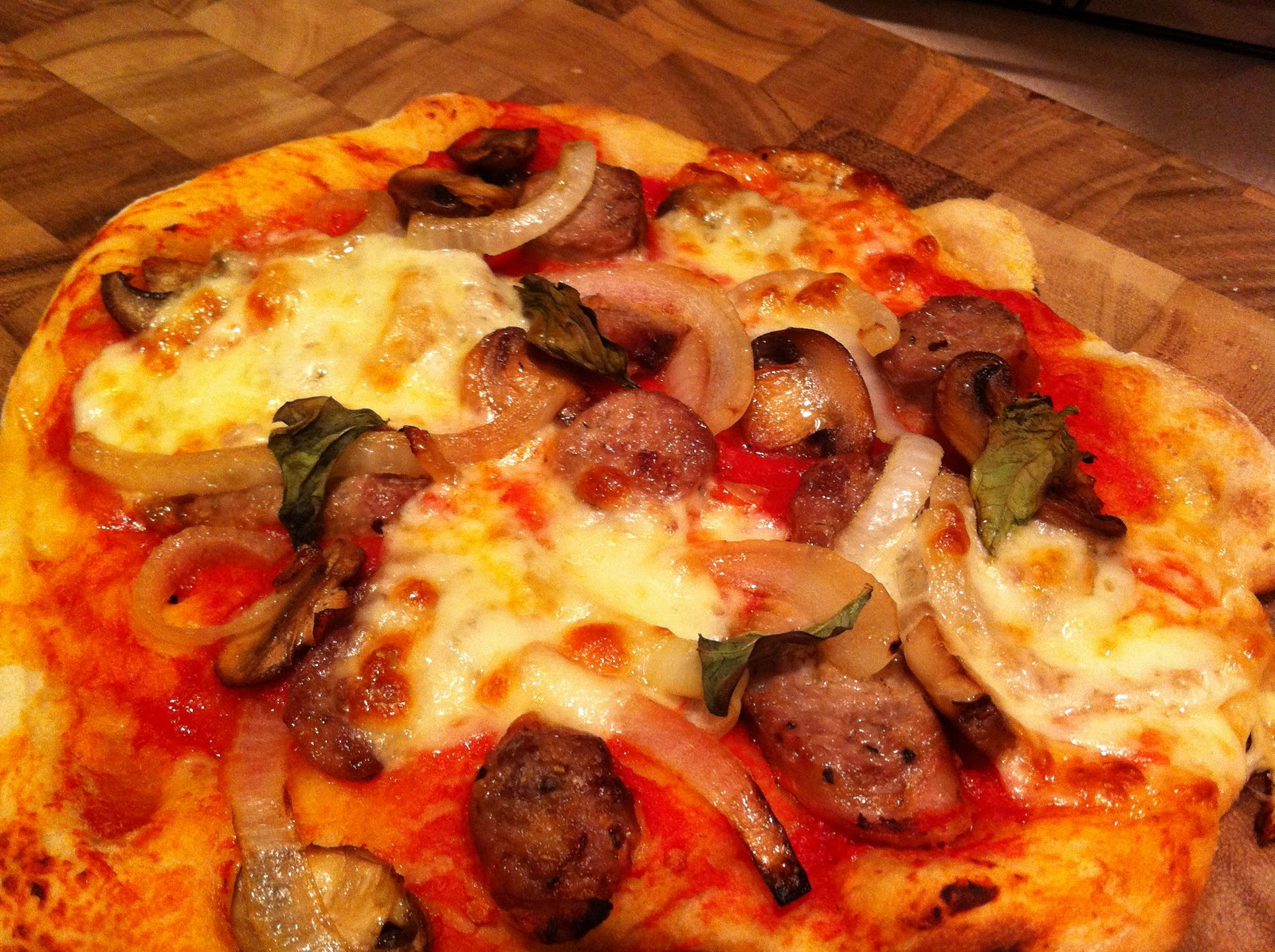
With that setup pizza is the perfect thing to make for a casual and social kind of dinner or get together. People stand around talking while they go to work concocting pizzas of their own, waiting anxiously to see how their creation evolves in the oven, hoping to impress everyone.  And when done right I think you can beat a lot of local places, brick oven or not.  Below are some things I've learned on the way to considering myself an aspiring pizzaiolo.

Make your own dough:
Unless you can get dough from your neighborhood artisan pizzeria that uses its own 25 year old natural yeast starter, your own creation will be the most rewarding. Working it from start to finish will develop your skills and it will yield something that much better than store bought. Plan on mixing the dough and letting it ferment overnight before actually cooking your pizzas.

Crank the oven up:
Nicole and I have our first ever gas oven, which is good and bad. We know that home gas ovens heat inconsistently, but they also get up to it faster than electric, and usually can get hotter overall. You're not baking a loaf of sandwich bread or muffins, so go 500 +. If you have convection, use it, and give your oven, regardless of type, 1 1/2 to 2 hours to get good and hot.

Use a pizza stone:
For better texture on the crust and more thorough cooking from bottom up, it's a good investment. Put it in the oven when you begin preheating it, as it'll take at least an hour to get primed. Put it on the lowest or middle rack of the oven to keep it close to the heating element. This will cook the denser crust quickly and get it well browned, while the toppings will have more indirect heat that allows for melting without burning.  While you're at it get a wooden or metal peel too for transferring the pizza to and from the stone.


We need an island
 Get Your Raw & Cooked Ducks on the Pond: Sometimes you want crunchy bell peppers, sometimes you want the more syrupy sweet ones already roasted our sauteed.  Keep that in mind when you're getting your mis en place ready if you have predetermined creations to execute.  A goat cheese pizza, for instance, might be better with onions previously caramelized and extra sweet rather than raw and pungent. 

Sausage is a bit of a risk to finish cooking in the 10-15 minutes I suggest it'll take for the pizza, so I pre-cook mine until just done, then let the surface brown when it's applied as a topping.  Prosciutto, when cooked, gets intensely salty, so you may want to add it right when you pull the pizza from the oven for a nice bit of textural contrast with the cooked toppings.  Arugula will sufficiently wilt from the residual heat when it hits a pizza that's just pulled from the oven, but retains its fresh pepperiness.             

Go individual:
Dividing the dough into 6 or more "individual" pizzas will yield better results than making one or two big pies, plus it allows for more personalization and a better flow. With them coming out of the oven every 10 to15 minutes, everyone gets to sample a small slice or two without filling up too fast.


Less is more:
Remember that good pizza is about the dough, the bread, not the lamb spread. A lot of people, when presented with a blank canvas of raw dough, want to put every topping they're craving on the first pizza.  But loading too many toppings can result in a mess that becomes soggy and improperly cooked, not too mention has too many things going on flavor-wise. I think you'll find a couple to a few quality ingredients cook best and make for the best texture. And try to keep a good border of an inch or so around the edge free of toppings so as to create a more bella figura.


Avoid Sogginess:
Going off the last point, overloading, especially with watery veggies, can lead to a soggy pizza where the top of the dough is gummy and undercooked, and the pizza limp. Fresh mozzarella is a frequent culprit of this too. People want to do the apizza faithful a favor by sourcing the freshest balls of cow or buffalo mozz suspended in brine, but it doesn't usually work out on pizza. The high water content can't usually be overcome by home ovens, leading to a milky ooze of water pooling in places on the surface of the pizza.   I suggest cutting it into small cubes and drying it for several hours on absorbent paper prior to pizza making.

A dryer form of whole milk mozzarella will make things easier.  It might be a challenge, but try to find a source of high quality fresh mozzarella that is not too watery--you may have to experiment with a few.  If you can get your oven up to 700° F or 800° F it will be able to evaporate the excess liquid and enable toppings to cook and brown, but most of us don't have that kind of equipment, so keeping liquid minimal is important.    


You don't need a complex tomato sauce that's been simmering for hours:
Traditional Pizza Margherita is made with San Marzano tomatoes, crushed or pureed but uncooked before they go on the pizza. The heat of the oven reduces the tomatoes, enhancing the sweet and acidic qualities, concentrating the flavor and making it saucy. I don't season my pureed tomatoes with anything but salt after spooning it on the dough and I find, even in the home oven, that it lends the pizza that authentic fresh tomato flavor. I add minced raw garlic on top of the tomatoes and any herbs as well at that point if I want something more aromatic.


Keep your damn hands off:
Just for a few minutes after retrieving the cooked pizza from the oven. This will allow any excess liquid to evaporate or be absorbed, and the structure and flavors will continue to improve as the pizza continues to cook a little. It also cuts down on the tendency for toppings to go one way and the crust the other, not to mention a burn to your tongue and mouth that will have you smarting the rest of the nizzight.

Bacon works really well on pizza...no need to pre-cook it either!

Experiment:
There's always enough dough to make one or two crowd-pleasing plain cheese pizzas, but from there the possibilities are almost endless. Most cheeses will work on pizza, it's just a matter of finding the right complimentary vegetables or other toppings to go with them. It's rare for a pizza to be so poorly done to be inedible, so be fearless. I do personally draw the line somewhere though...take a cue from the guy in the Polaner All Fruit commercial and don't call cooked dough with chicken and barbecue sauce on top pizza.

Wednesday, February 9, 2011

Chiappetta Extra Virgin Olive Oil: Organic and First Cold Pressed From the Toe of the Boot

Terroir is usually considered a sommelier term, a way to describe the unique characteristics a wine achieves from the soil, climate and situation in which the vines grow.  But I don't see why olive oil can't be appreciated on a similar level. 

After all, like the grape vine, the olive tree is a crop of biblical proportions, often aging into the hundreds of years, sometimes even thousands.  Long appreciated for its salubrious attributes, there are over three hundred cultivars of olive in Italy alone, making for a multitude of nuances and distinctions in flavor.  Whatever your tastes are, you ought to have a high quality olive oil on hand to enhance both your food and your well-being.   

That said, a lot of Italian olive oils these days, extra virgin or not, are blended; the bulk of the olives come from industrial-scale operations around the Mediterranean and are only bottled in Italy so as to be passed off as Italian.  They are sufficient for cooking, but typically lack the character and quality of those made to be consumed as "finishing" oils. 

Fortunately, Chiappetta Extra Virigin Olive Oil is an artisan product: their Carolea olives are grown organically in San Vincenzo La Costa, Calabria by a family with ninety years of experience.  Being first cold pressed  and extra virgin means that the fruit is ground to a paste and pressed in the traditional method only once, and throughout the process the olives are never heated above 80° F.  Treating them with this level of care keeps the acidity level very low (.8% or below for EV status) and reduces oxidization, which at higher levels will damage the flavor profile of the oil as well as destroy some of its nutritive qualities.  So basically from earth to bottle the Chiappettas do everything right to extract the best possible expression of olives in liquid form. 

The relatively recent appearance of this product on American shores is due to the collaboration of the Chiappetta family, both those still in the Cosenza area and their relatives here in Norwalk, CT and Toronto, Canada.  After years of producing their oil and selling it to larger firms in Italy to be bottled under someone else's label, the family began bottling and selling the oil as their own proprietary product in Italy.

It was when brothers Pat and Frank Chiappetta visited the family's property not too long ago that they realized the legacy and importance of their family's work for so many years.  They wanted to celebrate it and show their appreciation by availing it to more people.  Realizing the boundless market for premium olive oil (and organic to boot) in this country, they worked out the details to begin importing, bottling and labeling it here for retail.  Now it's truly a family business from start to finish, with Pat, Frank and all their children involved to support the growing business stateside.  It's brought the family, despite an ocean separating them, closer together.  The only incongruity now is in how the oil and the family name are pronounced: Kya-pett-a over there, Chya-pett-a here.          

Compared to the more popular Tuscan and Sicilian oils that currently dominate shelves, Chiappetta Extra Virgin Olive Oil is subtle in flavor. Lacking the pungency and pepperiness of Tuscan olive oil, and less direct in the grass and raw artichoke department than Sicilian, Chiappetta's tastes of fresh olives; fruity and with a distinct herbiness.  Pepper on the back of the tongue comes along gently at the finish, making for a very pleasant olive oil mild enough for a range of dishes.

Start by dipping good loaf of rustic bread in it for the litmus test.  From there I'm a big believer in respecting terroir across the board...so if I'm eating a dish akin to something found in Calabria, I'd like a wine and an olive oil from around there too.  A simple but satisfying dish that's Calabrese in spirit, as I mentioned on the Chiappetta website, is comprised of simply roasted peppers, eggplants and onions, garnished generously with this oil at the finish as a flavor enhancer, adding complexity and fullness on the palette. 

Not that you have to wait for Calabria Appreciation Night at home to break out a bottle...the mild fruitiness of this oil is ideal for simply grilled fish dishes where you don't want too much bitterness or pepper, and even white meats like poultry and pork.  Save it for the moment you serve a dish when the oil's aroma intensifies as it hits the other ingredients, producing another layer of flavor.

You can order Chiappetta Extra Virgin Olive Oil from their website, or by visiting the constantly increasing list of stores that sell it throughout Connecticut and New York, where they also host frequent tasting events.  The Kya-pett-as and Chya-pett-as will thank you.

Saturday, January 22, 2011

Gourmet Tucked Away in Norwalk: Nicholas Roberts

Nicole and I had the day off recently so we decided to go to the dog track and wet our beaks a little.  Before that though we wanted to find an inexpensive place for a quick lunch.  By fate perhaps we found ourselves at a frequently traversed crossroads in Norwalk...take a right down Main Street toward Joe's condo and Valencia Luncheria, go straight and take a walking tour of the News 12 facility, take a left toward Fat Cat or Nicholas Roberts.  Oh yeah, Nicholas Roberts, that place somewhere in Norwalk that supposedly has really good creative gourmet food. 

Not hard to find at all if you know where Talk of The Town Nightclub is.  No?  Driving down Main Street toward Wall Street, Nicholas Roberts is on the right and with prominent enough black on orange signage.  We walked through a heavy velvet curtain after entering the front door that gave way to a pretty open space, instantly changing the vibe from Hot & Speedy Pizza next door to something more hipster.  Inside is done up in that low cost HGTV way of faux walls, and features a large chalk on blackboard mural just above head level on the far wall (so as not to get smudged if people lean back I suppose).  Ikea furniture for the tables, probably covered with cloth for dinner as Nicole noted, but dressed down during the day.  There's a large case when you first enter on the left displaying some of the food for takeout if you're on the go. 

I forgot that the place is still cash-only, and we had about $15 between us.  It caught me off guard when we saw the sign and Nicole looked to me for our next move, but alas it would not be a problem...we could eat and then run to the ATM in the gas station at the intersection we were told.   

We began with a bowl of cauliflower and sweet onion soup, pureed but not quite smooth.  It was a sort of dull brown color from the caramelized onions, whose flavor was the most prominent of all.  Although we didn't get much cauliflower, it brought us instant warmth on a frigid day, nice earthy flavors without being too herby.  I thought I tasted some celery root in there; not as prominent as celery stalk, but an underlying and mild aroma of it. They were a little heavy-handed on the white pepper you might say, but it worked to give the soup a little bit of spice.

Nicole ordered a pulled pork sandwich served with sweet potato fries, and I went for the lamb kebab with their "famous" french fries on the side.  I was tempted by the potatoes roasted in duck fat, but being a first time customer I took the bait with the " " tag.  I also had an iced tea infused with chai and unsweetened but for the whole blackberries, blueberries and segments of strawberries floating in it.  I spent a good deal of the time between courses trying to stab the fruit and pull it up to my mouth, but then found that I could crush and suck little bits through the straw to the same effect.

We were having a late lunch but there were a handful of other people there enjoying the laid back vibe and snazzy music.  Despite the high ceilings the noise level wasn't a problem, but I could see it being a different story if it was full house and people were popping bottles.

Nicole's pulled pork was served on an ordinary store bought bun, with a cole slaw featuring apples atop the meat.  The texture of the pork was good, tender and chopped small, but I was hoping for a little more spice and vinegar, Eastern Caa-olina style.  The apple slaw was crunchy, the matchsticks of it big enough to feel in each bite, but again it lacked a little bit of tang for me.  Still, not a bad effort at pulled pork at all and hard to put down.  The sweet potato fries were cut thicker than normal fries, with the outsides not achieving that extra crunch that russets yield on the second fry.  I'm a big fan of the starchy sweetness though, and coarse grains of salt are enough garnish for me to make up one of my favorite sweet/salty endeavors.  Nicole opted for a ketchup bath, something I don't approve of with sweet potatoes.

As my plate came I had to taste a fry first to get it as fresh from the oil as possible.  Deliberately or not, the pile was made up of longer fries and lots of bits of irregular nubs that get an extra shade of brown and crunch by the time the regular sticks finish cooking.  They were quite good, ketchup or not, each one crunchy through and through. 

The lamb kebab was nicely wrapped warm in a flour tortilla and on the first bite through I got a wave of freshness from chopped parsley, mint and cilantro, all kind of playing off each other in that order.  The meat was comprised of little links of sausage, reminiscent of merguez and North Africa, flavored with cumin but giving off just a little bit of heat.  It was pretty lean, just discernible as lamb, and it oozed a little of its natural juice with each bite.  The yogurt dipping sauce was as advertised; really good herb and spicy that is.  It had a nice tang to it and was full of flavor to stand up to the abundant action of the meat and herb salad in the wrap.

It was a large lunch for us, a bit of a splurge since we're used to cereal and leftovers midday, but we were both thoroughly satisfied with the meal and the experience.  The ingredients used are of good quality, and the technique of chef Robert Troilo is obvious in the creativity and breadth of cuisines covered on the menu.  A hop skip and a jump over Route 1 and back with some cash and we got out of there for about $25.  We'd definitely come back on the rare occasion we're in the area at breakfast time knowing they're reputed for it.  And we'll keep it in mind for takeout on a weeknight when we're bereft of dinner ideas, or maybe for another lunch date on our way to Rrrrrraceway Park in the Spring.

NR does breakfast and lunch weekdays but closes around 3pm, so get the dinner takeout order in early.  They also do brunch on the weekends and have a full catering business.  Nicholas Troilo founded the business, Robert does the food, and that's where the name comes from.  Still without a liquor license, they encourage you to BYOB with a small corkage fee.  Ironically, they also have a wine business located on Route 1 in Darien.  Peter Troilo, somehow shafted when it came to naming the enterprise, runs that end of things.